Thought Leadership
AI’s Best Kept Secret: It Was Never Either/Or
Published September 26, 2026
Sep 26, 2026 · Kerry Beutel
What a 500-year-old goddess and a room full of independent agencies taught me about the future of marketing.
Last week I joined independent agency leaders from around the world at the AMIN Global Conference in Mexico City. Nearly every session was about AI. But the lesson I keep coming back to came from the city itself.
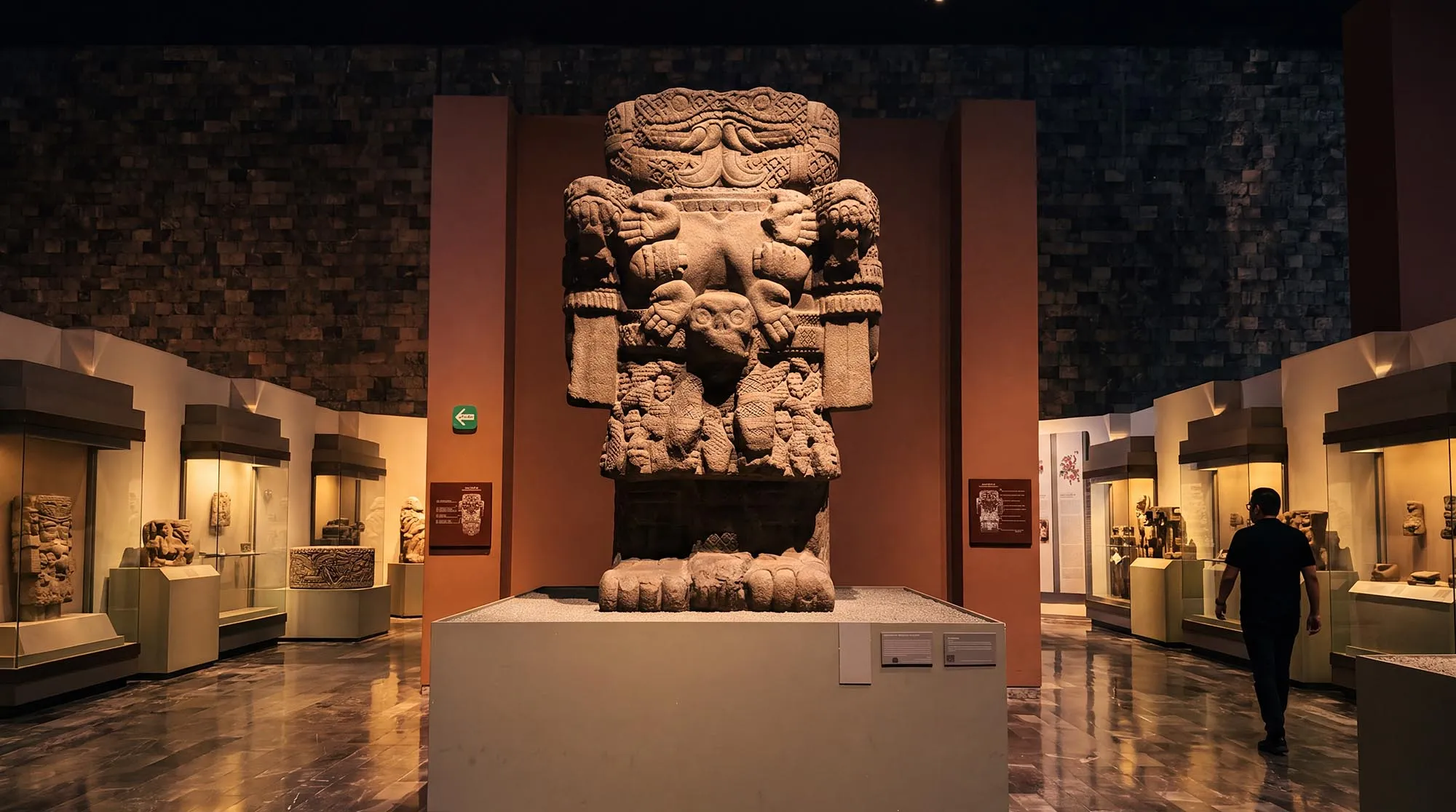
Between sessions, I visited the Museo Nacional de Antropología, and one statue stopped me cold. Coatlicue, the Mexica earth goddess, gives life and takes it back: she’s the mother of the gods and the earth that receives the dead. Her face isn’t a face at all. It’s two serpents meeting in the middle, two forces becoming one. That idea runs all through Mesoamerican thought. Everything has its counterpart and is balanced by it: life and death, day and night. Duality isn’t a contradiction to fix. It’s a way of seeing the world whole.
Back at the conference, I saw that same duality in the room itself. AMIN is a network of nearly 70 independent agencies in more than 30 countries, most of them small to mid-sized. Our differences are real: we work across languages, cultures and markets, under different regulations, and each of us faces challenges the others don’t. But our common ground is just as real. We’re all in the business of communicating with people, and we’re all fiercely creative. Even AMIN’s promise holds two ideas at once: independent, but never alone. And we’re all holding the same two truths at once: what makes great work has never changed, and how it gets made is changing every day.
At Worst Kept Secret, we see AI through the same lens as Coatlicue. Technology and people aren’t a contradiction we need to fix. They’re a duality we choose to embrace, because each makes the other stronger. Most of the industry frames AI as a choice: people or machines, efficiency or creativity, cost or craft. We think that’s the wrong question. Here are seven things I learned, and how we see each one through the lens of both/and.
1. The machines are ready. Truly.
On GDPval, a benchmark of 1,320 real tasks from 44 professions, AI output is judged blind against work by experts with an average of 14 years’ experience. In May 2024, AI won 12% of the time. By April 2026, it won 85%. A major content assignment that once took a team weeks can now be created, tested and optimized in a fraction of the time. As one speaker put it, a five-person shop now has the same resources as a 5,000-person network.
Our take: We’re all in. We’ve invested in AI across the agency to make our work smarter and faster. Not to replace our people, but to free up their focus so they can apply their expertise at a much larger scale.
2. But AI completes patterns. It doesn’t break them.
Ask an AI model for a random number and it picks 7 about 94% of the time. Models are built to predict the most likely next thing, which is exactly why they struggle with ideas nobody saw coming. Zoe Scaman, founder of Bodacious, compared it to “trying to get a calculator to write poetry.” Even in those blind tests, when AI loses, it loses on tone, storytelling and style.
Our take: Tone, storytelling and style are the whole job. Great brand work breaks patterns. That part stays human, and we like it that way.
3. The money is in the boring stuff.
Carnegie Mellon studied 500 public companies and found no link between revenue growth and AI hiring, AI spending, adoption rates or maturity scores. Only one factor mattered: naming specific tasks for AI, with numerical goals and measured results. Companies that did saw about 8% revenue growth. The best advice I heard all week was the simplest: start with the work that’s boring.
Our take: Everyone is chasing “cheaper and faster.” We’re chasing “better,” and we get there by handing AI the tedious work so our teams get their time back for strategy, creativity and clients.
4. Generic in, generic out.
58% of marketers using AI for strategy and creative rely on everyday consumer chatbots, not custom AI tools that know the brand. The top reason teams ignore AI recommendations? They feel generic. That’s the gap between memory and context. AI can store every brief and meeting note, but it doesn’t know why a client passed on a concept last spring, which stakeholder needs to see the numbers first, or what their customers are worried about right now.
Our take: Context is the edge. Our teams carry years of knowledge about our clients’ brands, businesses and people, and no model can download that. We feed that context into custom tools, and our people bring the judgment to use it well.
5. Faster doesn’t mean less.
Economists call it the Jevons Paradox: when something becomes more efficient, people end up using more of it, not less. When a client sees work that used to take six weeks come together in an afternoon, they don’t ask for less. They ask what else is possible. That cuts against a popular fear in our industry: that AI will take our jobs, and brands will bring everything in-house once their own teams can create with it.
Our take: More output needs more direction, not less. When anyone can make 20 versions, someone has to decide which one is right, hold it to the brand’s standards and make sure it actually works. That takes judgment, direction and oversight, and it’s exactly what a great agency brings.
6. AI is a language, not a tool.
You pick up a tool for a task and put it down. A language is something you become fluent in, and it changes how you think. Yet only about 5% of marketing employees say their employer has trained them well on AI. Fluency doesn’t come from an AI committee or a handful of power users. The biggest gains come from the middle of the team, when everyday people use AI reliably for everyday work.
Our take: Fluency is everyone’s job here, not just the “AI person’s.” Collaboration is how that happens: people teaching people, sharing what works and pushing each other forward.
7. Nobody has certainty. Lead anyway.
Colin Powell’s rule for decisions: act when you’re 40 to 70% sure. Below that is too early. Above it, the moment has usually passed. With AI, waiting has a real cost. The gap between agencies investing in AI and those holding back is small today, but it compounds. One speaker estimated it becomes a visible chasm within 18 months and an uncrossable one within three years. Meanwhile, most companies are stuck in “pilot purgatory”: committees, tool trials and policies, with no real change.
Our take: We’re not waiting for certainty. We’re leaning in now, testing, learning and trusting the patterns we see, so we land on the right side of that gap. And we’re bringing our clients with us. Every client has a different comfort level with AI, so we meet them where they are, with clear guardrails and tools that make their teams better too. We do it all with empathy for the people doing the work, on both sides.
Now it’s a worst kept secret: the future of this business isn’t human or machine. It’s both.
Held together on purpose, each one makes the other better. Technology gives us speed and scale. People give us creativity, judgment, empathy and the kind of collaboration that turns a good idea into a great one. Neither is enough on its own.
Coatlicue has held both sides of life for more than 500 years. We’re just applying the idea to marketing.
We won't tell anyone.
We'll tell everyone.
Contact UsEncrypted message :True
From :Worst Kept Secret
--- End of transcript ---
Sent from a secure device
Signal Strength :Strong
Status :Complete